

House Race Analyses, Political Climate, Senate Race Analyses
09/10/2018

State and Legislative Races Rated ‘Lean’ or ‘Toss Up’

TXElects

The general election is eight weeks away, and early voting begins six weeks from today.

Traditionally, we have rated contested elections on a 5-star scale, which one star indicating a very low-interest race with no chance of flipping and five stars indicating a high-interest race with a relatively high likelihood of flipping. Our Crib Sheets still reflect these ratings. In this analysis, we use the more frequently employed seven-point scale that divides seats into strong, likely, leaning and toss up categories.

Of the 215 federal, statewide and legislative seats on the ballot, we rate 156 as either strong Republican (92) or strong Democrat (64). Of those, 16 Republican and 30 Democratic candidates are unopposed, which is lower than in a typical election year. We rate 33 Republican and 3 Democrat-held seats as “likely” to remain with their respective parties. That leaves 22 seats we rate as either “leaning” (13 Republican, 2 Democratic) or “toss up” (7 Republican) on the general election ballot. We also rate next week’s SD19 special runoff election as “toss up.”

Today we look at state and legislative races. Tomorrow, we will look at the U.S. Senate and congressional races.

Statewide Races

Aside from the U.S. Senate race, we rate all other statewide races as “strong Republican” except for Attorney General and Agriculture Commission, which we rate as “likely Republican.” Atty. Gen. Ken Paxton (R) is under criminal indictment – the meandering case shows few signs of forward progress – and Comm. Sid Miller (R) has received several bouts of negative press during his term. Nonetheless, both of those races are much closer to “strong” than they are to “leaning.”

Texas Senate

The chamber’s only “toss up” race is not on the general election ballot. Early voting is underway for the September 18 special runoff election between Pleasanton retired game warden Pete Flores (R) and former Rep. and U.S. Rep. Pete Galleo (D-Alpine). The winner will serve the unexpired term of former Sen. Carlos Uresti (D-San Antonio), which expires in 2020. The district would lean Democratic if it were a general election, but Gov. Greg Abbott (R) called an emergency special election instead of waiting until November. We rate it a “toss up” because of the likely low turnout, especially from Democratic precincts in Bexar Co., and coordinated efforts by Republican leaders to turn out their vote.

We rate SD10, held by Sen. Konni Burton (R-Colleyville), and SD16, held by Sen. Don Huffines (D-Dallas), as “lean Republican.” In SD10, Beverly Powell (D) raised more than $500K as of June 30, which is about three quarters the amount raised by Burton. The district had the smallest straight-party advantage of any Republican-held seat in 2014, and Democrats closed the gap by more than half between 2012 and 2016. Former Sen. Wendy Davis (D-Fort Worth) was re-elected to the seat, as the district is currently configured, in 2012.

Relative to the state as a whole, SD16 has gotten nearly 10% more Democratic since 2002, highest of any Senate district. In 2016, the district was 3% bluer than the state, second only to Burton’s SD10. Democrat Nathan Johnson raised nearly $600K as of June 30, about 63% as much as Huffines, and more than any general election challenger facing an incumbent since Davis in 2008, as of June 30 of their respective election years. SD16 also has several overlapping hot races, including nearly two-thirds of CD32 and large swaths of HD102, HD108, HD114 and HD115.

We rate SD8 open (Angela Paxton), SD17 (Sen. Joan Huffman) and SD25 (Sen. Donna Campbell) as “likely Republican.” SD17 is the closest of these to “lean Republican.” Huffman has a greater edge in fundraising than either Burton or Huffines. The district is growing friendlier to Democrats but has much farther to go to become truly competitive. There is also less overlap of competitive races than in most other “lean” and “toss up” races. SD8 could move toward “lean” territory if Democratic down-ballot challengers show strong fundraising numbers early next month.

Texas House of Representatives

We rate seven Republican-held seats as “lean Republican,” five Republican-held seats as “toss up” and two Democrat-held seats as “lean Democratic.” Eight of these 14 seats are in Dallas Co., which we expect will be the biggest battleground of the election cycle. Three are in Harris Co., two are in Williamson Co. and one is in Travis Co.

We rate three Dallas Co. seats as “toss ups”:

  • HD105, held by Rep. Rodney Anderson (R-Grand Prairie)
  • HD114 open, where Lisa Luby Ryan (R) ousted Rep. Jason Villalba (R-Dallas) in the Republican primary; and
  • HD115, held by Rep. Matt Rinaldi (R-Irving).

Anderson and Rinaldi were among five Texas legislators to win re-election in 2016 despite facing a deficit in straight-party voting.

In 2016, HD105 was nearly 9 points more Democratic than the state as a whole, the highest percentage for any Republican-held seat. More than 3,500 more people voted straight-party Democratic in 2016 than in 2012 while the number of straight-party Republican votes fell by nearly 800. The resulting shift flipped the straight-party advantage toward the Democrats. Anderson needed 62% of the full-ballot vote to make up a 3,344-vote deficit in order to eke out Terry Meza (D) by 56 votes. She is running again this year but lags behind in fundraising.

In HD115, Rinaldi received 57% of the full-ballot vote to overcome an 1,835-vote deficit and prevail by a little over 1K votes. The precincts that comprise the district today have shifted their political views dramatically since 2002, when they were nearly 13 points redder than the state as a whole. By 2016, the district was 6 points bluer than the state as a whole, the second largest blue shift of any Republican-held district (HD136, see below). Rinaldi’s challenger, Addison attorney Julie Johnson, has out-raised Rinaldi nearly 3-to-1 for the election cycle (as of June 30). She is the only state House challenger to out-raise an incumbent in this cycle so far.

HD114 has followed a similar, though less dramatic, partisan arc as HD115, going from 7 points redder than the state in 2002 to 3.5 points bluer in 2016. Villalba outperformed other Republicans on the ticket in his district in 2016, including presidential nominee Donald Trump, who received 8,357 fewer votes than Villalba (Hillary Clinton carried HD114 with 52% of the vote.). However, Villalba is not on the ballot. Dallas attorney John Turner had a $91K advantage in cash on hand as of June 30 and, as of that time, had raised 82% of the amount raised by Ryan.

We rate HD134, held by Rep. Sarah Davis (R-Houston), and HD136, held by Rep. Tony Dale (R-Cedar Park), as “toss up” seats. Davis has proven herself adept at winning support from voters who might otherwise vote Democratic. In 2016, Davis received more votes than any other contested candidate on the ballot in the district except for Justice Eva Guzman (R) and Clinton. We estimate that around one out of every six voters cast ballots for Clinton and Davis. That alone would normally keep her off this list except for the incredible shift in straight-party voting toward the Democrats. Between 2012 and 2016, the number of straight-party Democratic votes increased 49% while straight Republican votes fell 4%. In four years, the Republican straight-party advantage dropped from nearly 12K to just 3K, the largest such swing for a Republican-held House district over that period. Whether the race remains a “toss up” will depend on the next fundraising reports. Houston oil and gas executive Allison Sawyer had raised less than 10% the amount Davis has raised through June 30, a figure well below the historical percentage below which a candidate’s chance of flipping a seat is considered viable.

In rapidly growing Williamson Co., HD136 has likewise seen a significant erosion in the Republican straight-party advantage, dropping from more than 7K in 2012 to 2K in 2016. That year, Dale’s district was the sixth bluest of any seat won by a Republican, ranking below only HD105, HD102 (which we’ll discuss in a moment), HD113 (likewise), HD115 and HD134. Dale was the highest Republican vote-getter for federal or state office on the ballot in a district Clinton won by 2.5 points and most Republicans received less than 50% of the vote. He faces Cedar Park businessman John Bucy, whom he defeated in 2014. Bucy has already raised more this year than during that entire election cycle. It’s worth noting that Libertarian candidates received an average of 7% of the vote in this district when facing a Democrat and a Republican, well above their statewide averages. There was no Libertarian candidate in 2016. This year, Libertarian Zach Parks is on the ballot.

Returning to Dallas Co., we rate four seats as “lean Republican” and one as “lean Democrat”:

  • HD102, held by Rep. Linda Koop (R-Dallas)
  • HD107, held by Rep. Victoria Neave (D-Dallas)
  • HD108, held by Rep. Morgan Meyer (R-Dallas)
  • HD112, held by Rep. Angie Chen Button (R-Garland); and
  • HD113 open, where Garland attorney Jonathan Boos (R) is seeking to hold the seat being vacated by Rep. Cindy Burkett (R-Sunnyvale).

We’ll begin by briefly touching on HD107. It is on the list because it was won by a Republican in 2014 and the freshman incumbent was arrested in June 2017 for driving while intoxicated. She faces Mesquite attorney Deanna Metzger, a conservative endorsed in the Republican primary by Empower Texans PAC, Texas Right to Life PAC and other movement conservative groups. Like several other Dallas Co. districts, it has been trending toward the Democrats over the years, shifting from 5% redder than the state as a whole in 2002 to 8% bluer in 2016. Yet, it remains one of two best pick-up hopes for Republicans.

Koop overcame a straight-ticket voting deficit to keep HD102 in 2016, when it was the second bluest district won by a Republican. Since 2002, the district’s current precincts have shifted from 10% redder than the state to 6% bluer. Like HD105, Democrats flipped the straight-party advantage in 2016, making up nearly 5K votes net against Republicans in that time. The district would have been rated a “toss up” except that Koop’s opponent, Richardson attorney Ana Maria Ramos, lags far behind in fundraising.

That HD108 is on this list is a bit remarkable. Anchored on the Park Cities, HD108 maintains the highest Republican straight-party advantage of the House districts discussed here. In 2016, that advantage was 6K votes, barely half of what it was four years earlier, yet Clinton defeated Trump by 6 points. Meyer faced only Libertarian opposition that year. Women voters could be decisive this time, and Meyer is one of 65 Republican men being challenged by a Democratic woman. University adjunct professor Joanna Cattanach raised about a third the amount Meyer had raised as of June 30.

Democrats nearly erased the Republican straight-party advantage in HD112 in 2016, chopping a nearly 5K-vote advantage to less than 500. Like many other Dallas Co. districts, HD112 is trending bluer, shifting from 7 points redder than the state in 2002 to 4 points bluer in 2016. Harder to track is Button’s performance relative to other Republicans in the district. Other than 2016, she has not faced a Democratic opponent since 2008. In that year, she received 56% to the Democrat’s 40%. In 2016, she defeated Jack Blackshear, 57%-43%. He raised just over $10K for the race. Button’s current Democratic opponent, Garland attorney and mediator Brandy Chambers, raised nearly 10 times that amount as of June 30.

As with the other Dallas Co. districts mentioned here, HD113 has also seen an erosion of Republican straight-party advantage as it shifted from 6% redder than the state as a whole in 2002 to 6% bluer in 2016. Burkett won around 70% of the vote from full-ballot voters – people who do not cast a straight-party vote – to defeat Rowlett community organizer Rhetta Bowers, 55%-45%. Burkett is not on the ballot this year, but Bowers is. She faces Garland attorney Jonathan Boos, an Empower Texans-backed conservative who lost to Burkett in the 2016 Republican primary. Bowers lags behind her 2016 fundraising pace but no longer faces an incumbent with crossover appeal.

Three other state House seats are rated as “lean Republican”:

  • HD47, held by Rep. Paul Workman (R-Austin)
  • HD52 open, where Cynthia Flores (R) is seeking to succeed former Rep. Larry Gonzales (R-Round Rock); and
  • HD138, held by Rep. Dwayne Bohac (R-Houston).

All three are slightly bluer than the state as a whole and are trending toward the Democrats. Workman’s HD47 is the lone Republican district in blue Travis Co., yet Trump carried the district by just 180 votes over Clinton. Workman’s vote total was in line with other Republicans running in the district against an opponent whom he out-raised, $682K to $24K. This year he faces Austin real estate agent Vikki Goodwin, who raised $138K as of June 30. Goodwin still trails Workman in contributions, but women voters could help overcome that gap. As far as straight-party voting goes, Republicans held a 6K-vote advantage in 2016, half of what it was in 2012.

Trump carried HD52 by 1K votes over Clinton while Republicans otherwise carried the district by around 6K votes. More than 7K more people cast straight-party Democratic votes in 2016 than in 2012, outpacing Republican growth by more than 2K votes. Flores, who Gonzales endorsed before the primary, faces Round Rock education nonprofit executive James Talarico, who had raised nearly $200K as of June 30. The district is a battleground for the competitive CD31 seat between longtime U.S. Rep. John Carter (R-Round Rock) and Round Rock nonprofit executive and former military pilot M.J. Hegar.

In HD138, Democrats cut a 7.5K-vote deficit in straight-party voting from 2012 into just a 2.5K-vote deficit in 2016. The number of straight-party Democratic voters increased 37% while the number of straight-party Republican voters fell 3%. As it is currently configured, HD138 has shifted from 13 points redder than the state in 2002 to 3 points bluer in 2016, with a significant amount of that jump occurring in the last couple of election cycles. Clinton won the district by 36 votes over Trump. Four years earlier, Mitt Romney carried the district by 20 points over President Obama. Bohac was unopposed in 2016, but now he faces Houston attorney Adam Milasincic, who raised $121K as of June 30, more than 60% the amount raised by Bohac.

Our final “lean Democratic” seat is HD144, which has changed partisan hands in every election cycle since it was drawn in 2012. Obama carried the district by 3 points in 2012, when Rep. Mary Ann Perez (D-Houston) was first elected, 52%-46%. Two years later, Greg Abbott defeated Wendy Davis by 5 points in the district, and Perez lost to Gilbert Peña by 152 votes. Turnout that year was 22%, one of the lowest in the state. Two years later, in rematch, Perez defeated Peña, 60%-40%, and Clinton carried the district by 19 points. Perez faces Ruben Villarreal, who has raised $25K as of June 30, well short of Perez’s $129K.

©2018 Texas Election Source LLC

🎙️We Have a Podcast! 🎙️

Bills and Business is your go-to podcast for conversations related to Texas legislation and business. Hosted by Laura Carr, Co-Founder of USLege—an AI-driven legislative tracking software—we bring you in-depth analysis on economic trends, impactful legislation, and key developments shaping Texas business.

Subscribe on Youtube and Spotify for weekly episodes!

🔍 USLege - The Only AI-First Political Tracking Solution ✨

USLege helps you track legislation and find what you need faster from bills, committee hearings, floor debates, and state agency meetings faster.

Say goodbye to tedious tasks!

You can follow USLege on LinkedIn, Facebook, and X.

🤝 Texas Association of Business 📈

Texas Association of Business (TAB) is the Texas State Chamber, representing companies of every size and industry. TAB’s purpose is to champion the best business climate in the world, unleashing the power of free enterprise to enhance lives for generations.

You can follow TAB on LinkedIn, Facebook, and X.

Table of Content
  1. 01 First
Trusted by Government Affairs Professionals and Corporate Policy Teams
Blog & Articles

Read more news

How AI Legislative Tracking Helps Teams Monitor Bills Across All 50 States
This is some text inside of a div block.

AI legislative tracking gives teams one clear way to follow every bill that matters to them, even when those bills move through 50 different state legislatures at the same time.

Instead of checking dozens of government websites by hand, you get a single feed that flags new bills, status changes, and votes as they happen.

This article breaks down how the technology works, why manual bill tracking falls short, and what to look for when you put a system like this to work.

Software powered by artificial intelligence scans state legislation around the clock, sorts it by topic, and alerts you the moment something changes.

That means less guesswork, fewer missed deadlines, and more time to act on the laws that affect your organization.

The volume of new bills is the real story. In 2023, lawmakers introduced fewer than 200 AI-related bills.

By 2025, all 50 states had introduced at least one, with about 1,208 such bills filed across the country.

By early 2026, lawmakers in 45 states had already filed more than 1,500 AI-related bills, passing all of 2024 in just the first few months.

No human team can read that much, but smart software can.

If you want to see how teams put this into practice, AI legislative tracking is the place to start.

0.1 Why Manual Bill Tracking Breaks Down in the Legislative Process

Picture a small policy team trying to watch new laws in California, Texas, Florida, and New York all at once.

Each state runs its own website.

Each one uses different words for the same idea. Each one posts updates on its own schedule.

The team checks every site by hand, copies bill numbers into a spreadsheet, and hopes nobody forgets to refresh the page.

This is slow, and it is easy to miss things.

Manual tracking tends to fail in a few common ways:

  • Missed bills. A new bill slips through because nobody searched the right keyword that week.
  • Stale information. A spreadsheet shows last month's status, not today's committee vote.
  • Wasted hours. Skilled staff spend the day on copy-and-paste work instead of analysis.
  • No early warning. By the time someone notices a bill, the comment window has already closed.

When you multiply these problems across all 50 states, the cracks turn into a real risk.

A single overlooked amendment can change how a law applies to your business.

And state bills are only part of the picture, since federal and local governments also pass their own rules.

0.2 How Artificial Intelligence Legislative Tracking Actually Works

The technology sounds complex, but the core idea is simple.

The program does the reading, so your team thinks.

Here is the basic flow most systems follow:

  1. Data ingestion. The tool continuously scrapes government websites and gathers real-time information from official sources across all states.
  2. Reading. Machine learning algorithms scan the bill text and figure out what each measure is really about, even when the wording is messy.
  3. Sorting. The system categorizes bills by topic, such as taxes, health care, employment, commerce, or data privacy.
  4. Matching. It compares each new bill against the keywords and issues you care about.
  5. Alerting. When a match appears or a status changes, you get a notification right away.

Because the software learns from patterns, it gets sharper at spotting the bills you want over time.

It can tell the difference between a bill that simply mentions your topic and one that would truly affect you.

A good legislation tracker can also boil a dense bill down to a short, useful summary.

That helps policymakers and staff grasp the intent of a proposed law without reading 40 pages of legal text.

Watching All 50 States Without the Headache

The biggest payoff is scale.

One person can track thousands of bills across the country from a single dashboard.

A few features make this possible:

  • Unified search. Type one keyword and see matching state legislation everywhere, not state by state, so you can identify relevant measures faster.
  • Real-time alerts. Get an email or text the moment a bill moves to committee or heads for a floor vote.
  • Status timelines. See where each bill sits in the legislative process, from introduction to enacted law.
  • Plain summaries. Read a short, clear recap instead of pages of dense language.

The strongest systems reach past statehouses, too.

They follow Congress, federal agencies, Washington, and even city and county governments, so nothing important falls through the gaps.

This can matter because state legislative sessions often run on tight calendars.

Some states meet for only a few months, and bills can move fast once a session starts.

Quick alerts give your team the head start it needs to weigh in before a vote.

The numbers show why speed counts. In 2024, lawmakers introduced roughly 635 AI-related bills across at least 45 states.

In 2025, that figure passed 1,200, and 145 of those measures became enacted legislation. The pace is not slowing down.

What These New Laws Actually Cover

The bills moving through state legislatures touch many parts of daily life. Knowing the broad buckets helps you set up smarter alerts.

Common themes in recent AI legislation include:

  • Transparency rules that ask companies to disclose when a person is talking to a machine.
  • Content labels for deepfakes, ads, and political messages, including rules for ai generated content and disclosures when material is generated by a system.

    By the start of 2025, more than 30 states had laws addressing nonconsensual explicit deepfakes, many of them passed during 2024.
  • Consumer protection measures that address the harms and risks of automated decisions often respond to public concerns and the potential impact on affected organizations or sectors.
  • Employment and hiring rules that limit how automated systems screen job applicants.
  • Government task forces that study new technologies, support education, and recommend future rules on AI and related technologies.

Some proposals focus on generative AI specifically, with each such proposal treated as an AI-related bill.

Some lawmakers argue AI tools like ChatGPT can threaten free speech under book bans.

Others warn the government's two-tiered approach could risk Americans' constitutional rights.

Tracking these themes lets your organization develop strategies before a rule takes effect, not after. Early insight turns a surprise into a plan.

To get a broader view of how state legislatures work and where official bill data comes from, the National Conference of State Legislatures publishes plain-language background on AI policy by state.

Pairing that knowledge with smart software helps your team understand both the rules and the tools.

0.5 The Practical Benefits and Actionable Insights for Teams

Faster information leads to better decisions. When you have access to reliable information, you can act with confidence instead of scrambling at the last minute.

Teams that use automated bill monitoring often see gains like these:

  • Time saved. Routine searching shrinks from hours to minutes.
  • Fewer surprises. Early alerts mean fewer last-minute fire drills.
  • Sharper focus. Staff spend their energy on strategy, not data entry.
  • Better coverage. Small teams can watch the same ground that once needed a large department.
  • Actionable insights. Trend analysis across dozens of bills shows where the law is heading next.

When AI is used in government, teams also need the right infrastructure and security to protect data privacy.

These benefits build on each other.

The more bills a team can watch, the better it can predict outcomes and protect the people it serves and each client.

0.6 What to Look For in a Legislation Tracker System

Not every tool fits every team, so it helps to explore your options before you commit.

Before you commit, it helps to weigh a few key factors side by side, including a vendor's methodology for tracking and analysis.

Feature Why It Matters
All-state coverage You never have to guess which states are missing
Federal and local reach You catch rules that start outside the statehouse
Custom alerts You only hear about bills that match your work
Clear summaries You grasp a bill fast, even without a law degree
Easy export You can share findings with your team or a client when relevant
Human oversight You catch the legal nuance a machine might miss
All-State Coverage
Feature All-state coverage
Why It Matters You never have to guess which states are missing
Federal and Local Reach
Feature Federal and local reach
Why It Matters You catch rules that start outside the statehouse
Custom Alerts
Feature Custom alerts
Why It Matters You only hear about bills that match your work
Clear Summaries
Feature Clear summaries
Why It Matters You grasp a bill fast, even without a law degree
Easy Export
Feature Easy export
Why It Matters You can share findings with your team or a client when relevant
Human Oversight
Feature Human oversight
Why It Matters You catch the legal nuance a machine might miss

That last row is worth a closer look.

AI can misread legal nuance, and it can even produce made-up references when its training data is thin.

The technology may also inherit bias from that data. So the goal is not to replace people.

The goal is to let software handle the heavy reading while humans handle the judgment.

How to Choose the Right Legislative Tracking and Management Software for Your Organization
This is some text inside of a div block.

Many organizations still rely on spreadsheets, scattered email alerts, and manual bill tracking methods that waste time and increase the risk of missing important updates.

As legislation moves through Congress, committee hearings, and state legislatures, even a small delay in tracking can create problems for stakeholders, clients, and government affairs teams.

Modern legislative tracking software gives users access to centralized data, advanced reporting, automated alerts, and collaboration tools that improve efficiency and support informed decisions.

For organizations involved in advocacy, public policy, government relations, or regulatory monitoring, the right system can help teams stay ahead of fast-moving policy changes.

Organizations comparing platforms often begin by reviewing solutions focused on legislative tracking and management software that combine legislative tracking, policy tracking, stakeholder engagement, and analysis into one system.

Why Legislative Tracking Matters More Than Ever

Government activity moves quickly across Congress, federal agencies, and state legislatures.

A single bill can move through committee assignments, amendments, hearings, and floor votes within days.

That pace creates pressure for public affairs professionals, advocacy groups, and government affairs professionals who need accurate information before making strategic decisions.

Legislative tracking helps organizations:

  • Track bills in real time
  • Monitor regulatory developments
  • Analyze policy developments
  • Stay informed about government actions
  • Support advocacy efforts
  • Improve stakeholder engagement
  • Save time on manual research

Without proper tracking software, teams may miss alerts tied to committee hearings, amendments, or policy changes that affect operations and compliance.

The Growing Complexity of Bill Tracking

Bill tracking has become harder because organizations now monitor legislation across multiple levels of government.

Federal legislation, local policy updates, and state law changes often overlap within the same policy areas.

Public affairs professionals often monitor:

Legislative Area Common Focus
Congress Federal legislation and funding
State legislatures State law and regulations
Local government Ordinances and zoning
Federal agencies Regulatory developments
Committees Committee hearings and amendments
Congress
Common Focus Federal legislation and funding
State Legislatures
Common Focus State law and regulations
Local Government
Common Focus Ordinances and zoning
Federal Agencies
Common Focus Regulatory developments
Committees
Common Focus Committee hearings and amendments

Many public affairs professionals use legislative tracking software because manual tracking can become overwhelming when teams need to follow hundreds of bills across different government systems.

On average, only about 6% of proposed legislation becomes law.

Even so, organizations still need to monitor every important bill because amendments and committee actions can influence policy before final passage.

Features Every Legislative Tracking Tool Should Include

Real Time Alerts

Real time alerts are one of the most important features in any legislative tracking tool.

Organizations need alerts that notify users immediately when:

  • A bill changes status
  • Committee hearings are scheduled
  • Amendments are introduced
  • Regulations are updated
  • Government actions affect policy areas
  • State legislators sponsor new legislation

Fast alerts help organizations stay ahead instead of reacting too late.

An effective legislative tracking tool should allow users to customize alerts based on:

  • Keywords
  • Policy areas
  • Committees
  • Sponsors
  • States
  • Date ranges
  • Regulatory topics

Real-time alerts can also be delivered through mobile notifications, dashboards, and email alerts, so users receive important information quickly.

AI-Powered Analysis and Summaries

Modern software increasingly uses machine learning to simplify legislative tracking and analysis.

AI-powered systems can:

  1. Summarize legislation
  2. Highlight changes in the bill text
  3. Identify trends in policy developments
  4. Categorize legislation automatically
  5. Generate actionable insights

These tools help public affairs professionals analyze legislation faster and make informed decisions without reviewing every page manually.

AI summaries are especially useful when Congress releases lengthy amendments or committee markups shortly before hearings.

Advanced Reporting and Analytics

Advanced reporting tools help organizations analyze legislative trends and support strategic decisions.

A strong legislative tracking tool should provide:

  • Custom dashboards
  • Exportable reports
  • Trend analysis
  • Search filtering
  • Stakeholder reports
  • Historical tracking

Advanced reporting also helps government affairs teams communicate updates clearly to leadership, clients, and stakeholders.

Organizations that rely heavily on advocacy and government relations often need advanced reporting to demonstrate policy influence and measure advocacy efforts.

Why Collaboration Features Matter

Legislative tracking is rarely handled by one person alone.

Government affairs teams, advocacy groups, legal departments, and compliance professionals often work together to analyze legislation and coordinate responses.

Good collaboration features allow users to:

  • Add comments to legislative records
  • Share analysis internally
  • Assign bills to team members
  • Add tags and labels
  • Monitor workflow progress
  • Track stakeholder engagement

These features help organizations operate more efficiently while reducing duplicate work.

Stakeholder Mapping and Relationship Management

Many legislative tracking software platforms now include stakeholder mapping tools.

These tools help organizations:

  • Track relationships with lawmakers
  • Monitor interactions with staff
  • Organize committee assignments
  • Analyze influence patterns
  • Build meaningful relationships

Government relations teams often use stakeholder mapping to identify opportunities to influence policy and engage decision-makers more effectively.

For example, organizations may analyze committee assignments to determine which lawmakers influence specific policy areas.

Coverage Across Multiple Levels of Government

The best policy tracking systems monitor legislation across multiple levels of government.

That includes:

  • Congress
  • Federal agencies
  • State legislatures
  • Local governments
  • Regulatory agencies

Broad coverage helps organizations stay informed about policy changes that may affect operations nationally and regionally.

Organizations involved in public policy or advocacy often need access to federal legislation alongside state law and local regulations.

Without broad coverage, users may miss important government actions tied to interconnected policy developments.

How Legislative Tracking Software Improves Efficiency

Manual bill tracking requires staff to search the government website for updates.

That process consumes valuable resources and increases the chance of missing critical alerts.

Tracking software improves efficiency by automating:

  • Bill monitoring
  • Status updates
  • Alerts
  • Search functions
  • Reporting
  • Policy tracking
  • Data organization

Automated tracking allows users to focus on analysis and advocacy instead of repetitive administrative work.

Legislative tracking software also helps organizations stay ahead by providing early warnings about committee hearings, proposed legislation, and regulatory developments.

What Public Affairs Professionals Need Most

Public affairs professionals often manage large volumes of legislative data under tight deadlines.

To support that work, software should provide:

  • Easy access to information
  • Fast search capabilities
  • Accurate alerts
  • Real-time analysis
  • Collaboration tools
  • Support for advocacy efforts

Public affairs professionals also need tools that simplify communication with stakeholders and clients.

The ability to export reports, organize policy tracking, and monitor government actions in one place can deliver results faster than fragmented systems.

The Importance of User Experience

A legislative tracking tool may include advanced features, but poor usability can limit effectiveness.

Organizations should evaluate:

  • Dashboard layout
  • Navigation speed
  • Search performance
  • Mobile access
  • Reporting design
  • Support options

Simple interfaces help users act quickly during fast-moving legislative process updates.

Government affairs professionals often need immediate access to bill information during hearings, advocacy meetings, or policy reviews.

If software is difficult to use, teams may avoid the system entirely.

Scalability for Small Teams and Large Enterprises

Organizations vary widely in size.

Some advocacy groups monitor a handful of bills, while large enterprises track legislation across all 50 states and Congress simultaneously.

Scalable tracking software should support:

  • Growing data volumes
  • Additional users
  • Expanded policy tracking
  • Multi-state monitoring
  • Large reporting needs

Affordability also matters because software pricing can vary significantly.

Smaller organizations may prioritize cost-effective tools with basic bill tracking and alerts, while large enterprises may need advanced reporting, stakeholder mapping, and machine learning capabilities.

Questions Organizations Should Ask Before Choosing Software

Before selecting a legislative tracking tool, organizations should evaluate operational needs carefully.

Key Questions to Ask

Question Why It Matters
Does the software monitor federal legislation and state law? Broad coverage improves tracking
Are real-time alerts customizable? Users receive relevant updates
Does the system support collaboration? Teams coordinate more efficiently
Are advanced reporting features included? Leadership needs clear analysis
Can users search historical data? Research and policy analysis improve
Does the platform support mobile access? Teams stay informed anywhere
Is stakeholder engagement included? Advocacy efforts become more organized
Does the provider offer support and training? Faster adoption improves efficiency
Federal & State Legislation
Question Does the software monitor federal legislation and state law?
Why It Matters Broad coverage improves tracking
Real-Time Alerts
Question Are real-time alerts customizable?
Why It Matters Users receive relevant updates
Collaboration
Question Does the system support collaboration?
Why It Matters Teams coordinate more efficiently
Reporting Features
Question Are advanced reporting features included?
Why It Matters Leadership needs clear analysis
Historical Data
Question Can users search historical data?
Why It Matters Research and policy analysis improve
Mobile Access
Question Does the platform support mobile access?
Why It Matters Teams stay informed anywhere
Stakeholder Engagement
Question Is stakeholder engagement included?
Why It Matters Advocacy efforts become more organized
Support & Training
Question Does the provider offer support and training?
Why It Matters Faster adoption improves efficiency

Organizations should also review how quickly the software processes legislative updates from congress and state legislatures.

Fast updates help teams stay ahead of competitors and respond more effectively to policy developments.

How Legislative Tracking Supports Advocacy

Advocacy organizations depend on accurate tracking to influence policy and coordinate outreach.

Legislative tracking helps advocacy groups:

  • Monitor legislation
  • Engage stakeholders
  • Analyze policy changes
  • Organize government relations
  • Respond to committee hearings
  • Support strategic decisions

Strong policy tracking systems also help advocacy organizations communicate with clients and leadership more clearly.

Texas Political Spotlight
This is some text inside of a div block.
Can you make James run a marathon? Every demo booked in April adds a mile to his run on the Texas Capitol grounds. Book a demo. Add a mile.
Happy hour · You’re invited
Join us in celebrating.

You’re invited to celebrate our founder’s birthday with us for happy hour. RSVP and we’ll send you the details.

RSVP to the happy hour →
Best in Government Affairs · Texas
Peer nominated. Peer reviewed.

Unlike other awards, next year you have the chance to win. Just nominate someone you would actually want to work with. See photos and winners from the night.

See the photos and winners →
USLege Best in Government Affairs Texas 2025: peer-reviewed crystal awards lined up before the ceremony
Texas Senate Republican Caucus · Gala & golf tournament
Photos from the night.

USLege was a sponsor. See the full photo set from the gala and golf tournament.

Browse the photos →
For existing customers

Already on USLege? Get a 30-minute walkthrough of what’s new with our wider lens, with your account manager Luke.

Book training with Luke →

This newsletter is AI generated and human reviewed. Strictly nonpartisan. Built on USLege legislative data and verbatim public-record transcripts.

Built with the power of USLege.

USLege, Inc. © 2026 · Austin, TX
Texas Political Spotlight
This is some text inside of a div block.
Can you make James run a marathon? Every demo booked in April adds a mile to his run on the Texas Capitol grounds. Book a demo. Add a mile.
Happy hour · You’re invited
Join us in celebrating.

You’re invited to celebrate our founder’s birthday with us for happy hour. RSVP and we’ll send you the details.

RSVP to the happy hour →
Best in Government Affairs · Texas
Peer nominated. Peer reviewed.

Unlike other awards, next year you have the chance to win. Just nominate someone you would actually want to work with. See photos and winners from the night.

See the photos and winners →
USLege Best in Government Affairs Texas 2025: peer-reviewed crystal awards lined up before the ceremony
Texas Senate Republican Caucus · Gala & golf tournament
Photos from the night.

USLege was a sponsor. See the full photo set from the gala and golf tournament.

Browse the photos →
For existing customers

Already on USLege? Get a 30-minute walkthrough of what’s new with our wider lens, with your account manager Luke.

Book training with Luke →

This newsletter is AI generated and human reviewed. Strictly nonpartisan. Built on USLege legislative data and verbatim public-record transcripts.

Built with the power of USLege.

USLege, Inc. © 2026 · Austin, TX
Texas Political Spotlight
This is some text inside of a div block.

Welcome back, friends

Texas hemp businesses have filed suit to block new state regulations they say effectively ban smokeable hemp products and impose licensing fee increases so steep they could force many businesses to close. Yesterday, the Texas House State Affairs Committee heard testimony on the explosive growth of data centers in the state, with interconnection requests on the power grid now exceeding 400,000 megawatts and raising questions about cost, reliability, and water usage. Lastly, nineteen Texas summer camps are challenging a new state mandate requiring them to install fiber optic internet infrastructure, citing costs as high as $1.2 million and arguing the requirement is unworkable for rural properties and does nothing to improve camper safety.

Before you dive in…

USLege will be hosting our first ever Best in Government Affairs Awards Ceremony on April 23rd at Speakeasy in Downtown Austin.

Winners and guests will be treated to evening of celebration for the accomplishments in the 89th Texas Legislative Session.

You can expect music, networking, food & drinks and formal award acceptance.  

This is going to be a fun party! We hope to see you there.

»» RSVP HERE: Best in Government Affairs Awards Ceremony hosted by USLege

»» Watch Representative Ken King’s Intro Here ««

We hope you enjoyed today’s read!

Stay connected with TXLege News on X and LinkedIn!

Texas Political Spotlight
This is some text inside of a div block.

Welcome back, friends

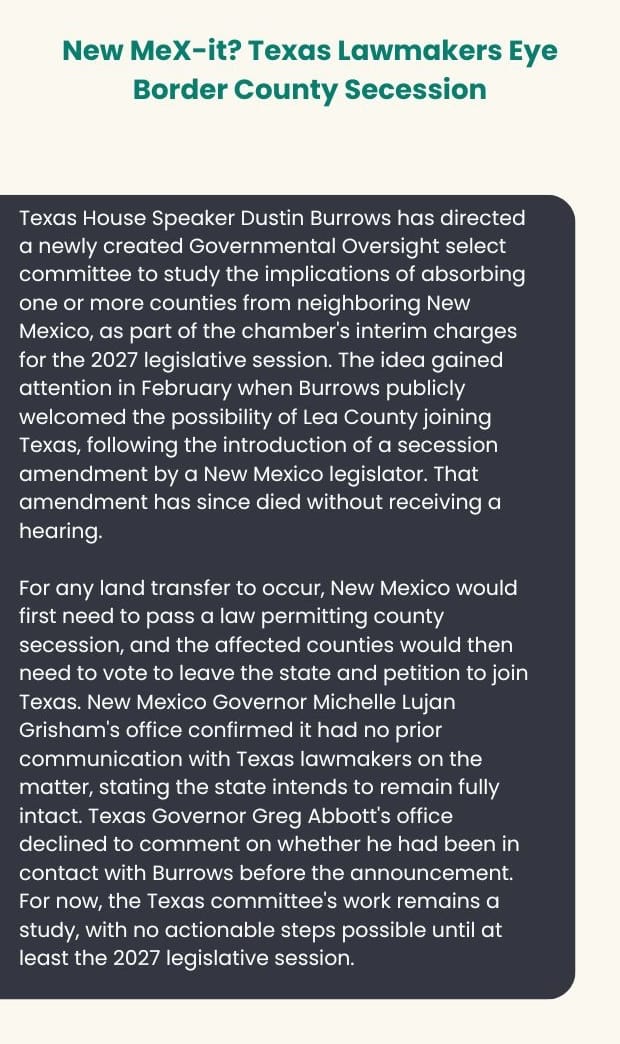
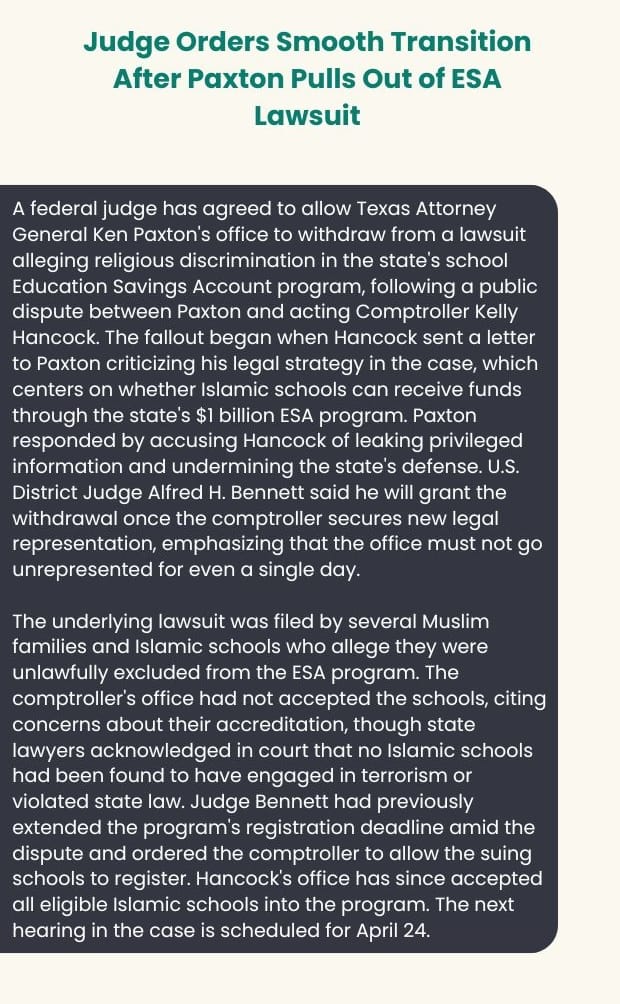
A federal trial is underway in Texas over whether the state's prison system has done enough to protect inmates from extreme heat, with a price tag of $1.5 billion standing at the center of the debate. Texas House Speaker Dustin Burrows has tasked a new legislative committee with studying whether Texas could absorb one or more counties from New Mexico, a long-shot proposal that has already drawn a sharp response from the neighboring state's governor. A public feud between Texas Attorney General Ken Paxton and acting Comptroller Kelly Hancock has spilled into federal court, where a judge is overseeing the fallout in a lawsuit alleging religious discrimination in the state's $1 billion ESA Program.

We hope you enjoyed today’s read!

Stay connected with TXLege News on X and LinkedIn!