

House Race Analyses
08/02/2020

Analysis of Key House Races in Collin, Denton Cos.

TXElects

Four suburban North Texas districts are at various stages of turning increasingly competitive or outright friendly to Democratic candidates. One flipped in 2018. Two more are poised to flip in 2020, and the fourth may remain just out of reach, even though it, like the other three, was bluer than the state two years ago.

When they were drawn in 2011, the four districts ranged between 3.3 and 6.5 percentage points redder than the state as a whole based on the 2010 general election. As late as 2016, three were still 0.7 to 3.2 percentage points redder than the state as a whole, but the fourth had crossed over and was now 2 full percentage points bluer. Following President Trump’s election, all four districts suddenly shifted between 2.6 and 4 percentage points bluer, ending the legislative career of then-Rep. Ron Simmons (R-Carrollton) and creating close calls for Reps. Jeff Leach (R-Allen) and Matt Shaheen (R-Plano). Rep. Lynn Stucky (R-Sanger) won more comfortably, but it was nonetheless the closest race in HD64 in its current configuration.

Download chart

We project those blue-ward shifts to continue, though not by as much as the last cycle, and rate HD65 and HD66 as Lean Democratic, HD67 as a Toss Up and HD64 as Lean Republican.

A large part of the political shift in these districts has been driven by an increase in straight-party Democratic voting. Even though the single-punch, straight-party option is not on the ballot in 2020, its recent history weighs heavily on our projections. Around 70% of straight-party votes were cast by Republicans in these four districts in 2010, the last election before the districts were drawn. By 2018, the Republican share of straight-party votes had slipped to between 47% and 48% in HD65, HD66 and HD67. In HD64, it had fallen to 58%. A record number of straight-party Democratic votes were cast in each district in 2018, nearly triple the amounts cast four years earlier.

As a result, the Republican incumbents’ and candidates’ advantage in straight party voting fell in each district to their lowest levels since they were drawn.

Download chart

We included 2008 in this chart because that was a relative high-water mark for Democrats, particularly in the Texas House, who came within one seat of a tie only to fall to a historic low two years later as the state’s voters reacted to President Obama’s first two years in office. Very high Democratic turnout in 2018, relative the two most recent gubernatorial election years, was likely a response to President Trump’s first two years in office, bolstered by an engaging and well-funded U.S.Senate campaign from former U.S. Rep. Beto O’Rourke (D-El Paso).

But something else happened in these four districts. For the first time since they were drawn, the Democratic challenger won a majority of the full-ballot vote in each district. Full-ballot voters are anyone who does not cast a single-punch, straight-party vote, and thus they vote their full ballot (or at least selective races) by marking names individually. Between 2012 and 2016, no Democratic candidate for any of these districts had received at least 40% of the full-ballot vote. In 2018, the received between 51% and 58% percent, and that latter number was enough for Michelle Beckley (D-Carrollton) to overcome Simmons’s straight-party voting advantage. The shift in full-ballot voting in all four districts was dramatic from 2016 to 2018:

  • Shaheen – 20.5 percentage points, from 65.9% in 2016 to 46.4% in 2018
  • Simmons – 18.9 percentage points, from 61.2% to 42.3%
  • Stucky – 14.4 percentage points, from 61.1% to 46.7%; and
  • Leach – 13.6 percentage points, from 62.4% to 48.8%.

We have historically considered full-ballot voters to be “independents” in the sense that they did not vote an entirely partisan ballot. Many may very well have voted mostly, if not entirely, for candidates of one party. What’s clear in these districts is that the lean of this group of voters shifted toward the Democrats following Trump’s election.

Trump won all four districts in 2016. Three of them – HD65, HD66 and HD67 – were among his smallest margins of victory of any district in the state, including state Senate and congressional districts. In the chart below, the Republican listed was the incumbent entering the 2018 general election. Sixteen of these seats flipped in 2018.

Download chart

In addition to the shift in the district’s electorate generally, we look at whether individual candidates tend to over- or under-perform the other candidates on the ticket in the district. In 2018, Stucky over-performed by 1.4 percentage points, but the other three incumbents in these districts under-performed. Shaheen received 1.1 percentage points less than the average statewide Republican, measured head-to-head against the Democrats, while Simmons (0.3%) and Leach (0.2%) finished closer to the mean.

So far, this analysis has focused on partisan labels and the incumbents’ past performance while ignoring their actual opponents. We’ll take each in turn.

HD64 (Lean Republican): Stucky faces Denton university adjunct professor Angela Brewer, who was unopposed in the Democratic primary. Thus far, Stucky has significant advantages in campaign resources, out-raising the challenger, $268K to $68K, and outspending her, $239K to $21K, through June 30. He entered July with a $160K advantage in cash on hand. Brewer has been endorsed by Annie’s List and various progressive groups, but that has not yet led to competitive levels of fundraising.

HD65 (Lean Democratic): Freshman Rep. Michelle Beckley (D-Carrollton) is the second most vulnerable Democratic incumbent this cycle based on our projections, and this is probably the best shot the Republicans have at a pick-up. She faces Lewisville business owner Kronda Thimesch, who has out-raised the incumbent, $215K to $177K, for the cycle and has a slight advantage in cash on hand, $64K to $49K. Beckley’s COH total is the lowest for any Democratic incumbent defending what we consider a competitive seat this year, and she raised just $64K since her primary victory over Paige Dixon, 67%-33%. Thimesch defeated Nancy Cline, 58%-42%, in the Republican primary and has raised $88K since.

HD66 (Lean Democratic): Shaheen faces a rematch against Plano school administrative aide Sharon Hirsch, who came within 1K votes of flipping the seat in 2018. The challenger has out-raised Shaheen, $292K to $191K, for the election cycle, including a $218K to $46K advantage in the last reporting period. Shaheen was unopposed in the primary, so his last reporting period was the first six months of the year. Hirsch had a primary opponent, so her reporting period began in late February. Hirsch has already raised more than triple the amount she received during the entire 2017-18 election cycle. Shaheen’s campaign strength cannot be evaluated solely based on contributions. He is capable of self-funding if needed and outspent Hirsch by more than $800K last cycle.

HD67 (Toss Up): Leach holds significant advantages over challenger Lorenzo Sanchez, a Plano real estate agent. The incumbent has $409K more on hand, has out-raised the challenger by more than $418K, has outspent the challenger by more than 3-to-1, and Leach had no primary opponent. Sanchez narrowly defeated Tom Adair, 51%-49%, after the two emerged from a four-way primary election. Leach held even larger advantages over his 2018 opponent, who he defeated by fewer than 2K votes. Sanchez has already raised nearly triple the total raised by Leach’s 2018 challenger. That said, the candidate we thought was the strongest potential challenger, Rocio Gosewehr Hernandez, narrowly missed the runoff, finishing just behind Sanchez. She endorsed Sanchez shortly after the March primary.

Democrats’ road to a House majority likely requires holding HD65 and flipping HD66 and HD67. We expect all three Democratic nominees to receive significant financial support in the coming months, as we also expect the Republicans to remain competitive and probably ahead in every race discussed here.

Our models are based on trends and hard numbers, not individual candidates’ appeals to voters. In an era when straight-party voting reached as high as 70% of all votes cast, there is little room for a candidate to break meaningfully better (or worse) than their party’s other candidates. That’s our expectation here. The greater partisan lean of voters, especially those who traditionally did not vote straight-party, will likely have more impact in each of these races than any single candidate, particularly when the presidential contest looms so large.

©2020 Texas Election Source LLC

🎙️We Have a Podcast! 🎙️

Bills and Business is your go-to podcast for conversations related to Texas legislation and business. Hosted by Laura Carr, Co-Founder of USLege—an AI-driven legislative tracking software—we bring you in-depth analysis on economic trends, impactful legislation, and key developments shaping Texas business.

Subscribe on Youtube and Spotify for weekly episodes!

🔍 USLege - The Only AI-First Political Tracking Solution ✨

USLege helps you track legislation and find what you need faster from bills, committee hearings, floor debates, and state agency meetings faster.

Say goodbye to tedious tasks!

You can follow USLege on LinkedIn, Facebook, and X.

🤝 Texas Association of Business 📈

Texas Association of Business (TAB) is the Texas State Chamber, representing companies of every size and industry. TAB’s purpose is to champion the best business climate in the world, unleashing the power of free enterprise to enhance lives for generations.

You can follow TAB on LinkedIn, Facebook, and X.

Table of Content
  1. 01 First
Trusted by Government Affairs Professionals and Corporate Policy Teams
Blog & Articles

Read more news

How AI Legislative Tracking Helps Teams Monitor Bills Across All 50 States
This is some text inside of a div block.

AI legislative tracking gives teams one clear way to follow every bill that matters to them, even when those bills move through 50 different state legislatures at the same time.

Instead of checking dozens of government websites by hand, you get a single feed that flags new bills, status changes, and votes as they happen.

This article breaks down how the technology works, why manual bill tracking falls short, and what to look for when you put a system like this to work.

Software powered by artificial intelligence scans state legislation around the clock, sorts it by topic, and alerts you the moment something changes.

That means less guesswork, fewer missed deadlines, and more time to act on the laws that affect your organization.

The volume of new bills is the real story. In 2023, lawmakers introduced fewer than 200 AI-related bills.

By 2025, all 50 states had introduced at least one, with about 1,208 such bills filed across the country.

By early 2026, lawmakers in 45 states had already filed more than 1,500 AI-related bills, passing all of 2024 in just the first few months.

No human team can read that much, but smart software can.

If you want to see how teams put this into practice, AI legislative tracking is the place to start.

0.1 Why Manual Bill Tracking Breaks Down in the Legislative Process

Picture a small policy team trying to watch new laws in California, Texas, Florida, and New York all at once.

Each state runs its own website.

Each one uses different words for the same idea. Each one posts updates on its own schedule.

The team checks every site by hand, copies bill numbers into a spreadsheet, and hopes nobody forgets to refresh the page.

This is slow, and it is easy to miss things.

Manual tracking tends to fail in a few common ways:

  • Missed bills. A new bill slips through because nobody searched the right keyword that week.
  • Stale information. A spreadsheet shows last month's status, not today's committee vote.
  • Wasted hours. Skilled staff spend the day on copy-and-paste work instead of analysis.
  • No early warning. By the time someone notices a bill, the comment window has already closed.

When you multiply these problems across all 50 states, the cracks turn into a real risk.

A single overlooked amendment can change how a law applies to your business.

And state bills are only part of the picture, since federal and local governments also pass their own rules.

0.2 How Artificial Intelligence Legislative Tracking Actually Works

The technology sounds complex, but the core idea is simple.

The program does the reading, so your team thinks.

Here is the basic flow most systems follow:

  1. Data ingestion. The tool continuously scrapes government websites and gathers real-time information from official sources across all states.
  2. Reading. Machine learning algorithms scan the bill text and figure out what each measure is really about, even when the wording is messy.
  3. Sorting. The system categorizes bills by topic, such as taxes, health care, employment, commerce, or data privacy.
  4. Matching. It compares each new bill against the keywords and issues you care about.
  5. Alerting. When a match appears or a status changes, you get a notification right away.

Because the software learns from patterns, it gets sharper at spotting the bills you want over time.

It can tell the difference between a bill that simply mentions your topic and one that would truly affect you.

A good legislation tracker can also boil a dense bill down to a short, useful summary.

That helps policymakers and staff grasp the intent of a proposed law without reading 40 pages of legal text.

Watching All 50 States Without the Headache

The biggest payoff is scale.

One person can track thousands of bills across the country from a single dashboard.

A few features make this possible:

  • Unified search. Type one keyword and see matching state legislation everywhere, not state by state, so you can identify relevant measures faster.
  • Real-time alerts. Get an email or text the moment a bill moves to committee or heads for a floor vote.
  • Status timelines. See where each bill sits in the legislative process, from introduction to enacted law.
  • Plain summaries. Read a short, clear recap instead of pages of dense language.

The strongest systems reach past statehouses, too.

They follow Congress, federal agencies, Washington, and even city and county governments, so nothing important falls through the gaps.

This can matter because state legislative sessions often run on tight calendars.

Some states meet for only a few months, and bills can move fast once a session starts.

Quick alerts give your team the head start it needs to weigh in before a vote.

The numbers show why speed counts. In 2024, lawmakers introduced roughly 635 AI-related bills across at least 45 states.

In 2025, that figure passed 1,200, and 145 of those measures became enacted legislation. The pace is not slowing down.

What These New Laws Actually Cover

The bills moving through state legislatures touch many parts of daily life. Knowing the broad buckets helps you set up smarter alerts.

Common themes in recent AI legislation include:

  • Transparency rules that ask companies to disclose when a person is talking to a machine.
  • Content labels for deepfakes, ads, and political messages, including rules for ai generated content and disclosures when material is generated by a system.

    By the start of 2025, more than 30 states had laws addressing nonconsensual explicit deepfakes, many of them passed during 2024.
  • Consumer protection measures that address the harms and risks of automated decisions often respond to public concerns and the potential impact on affected organizations or sectors.
  • Employment and hiring rules that limit how automated systems screen job applicants.
  • Government task forces that study new technologies, support education, and recommend future rules on AI and related technologies.

Some proposals focus on generative AI specifically, with each such proposal treated as an AI-related bill.

Some lawmakers argue AI tools like ChatGPT can threaten free speech under book bans.

Others warn the government's two-tiered approach could risk Americans' constitutional rights.

Tracking these themes lets your organization develop strategies before a rule takes effect, not after. Early insight turns a surprise into a plan.

To get a broader view of how state legislatures work and where official bill data comes from, the National Conference of State Legislatures publishes plain-language background on AI policy by state.

Pairing that knowledge with smart software helps your team understand both the rules and the tools.

0.5 The Practical Benefits and Actionable Insights for Teams

Faster information leads to better decisions. When you have access to reliable information, you can act with confidence instead of scrambling at the last minute.

Teams that use automated bill monitoring often see gains like these:

  • Time saved. Routine searching shrinks from hours to minutes.
  • Fewer surprises. Early alerts mean fewer last-minute fire drills.
  • Sharper focus. Staff spend their energy on strategy, not data entry.
  • Better coverage. Small teams can watch the same ground that once needed a large department.
  • Actionable insights. Trend analysis across dozens of bills shows where the law is heading next.

When AI is used in government, teams also need the right infrastructure and security to protect data privacy.

These benefits build on each other.

The more bills a team can watch, the better it can predict outcomes and protect the people it serves and each client.

0.6 What to Look For in a Legislation Tracker System

Not every tool fits every team, so it helps to explore your options before you commit.

Before you commit, it helps to weigh a few key factors side by side, including a vendor's methodology for tracking and analysis.

Feature Why It Matters
All-state coverage You never have to guess which states are missing
Federal and local reach You catch rules that start outside the statehouse
Custom alerts You only hear about bills that match your work
Clear summaries You grasp a bill fast, even without a law degree
Easy export You can share findings with your team or a client when relevant
Human oversight You catch the legal nuance a machine might miss
All-State Coverage
Feature All-state coverage
Why It Matters You never have to guess which states are missing
Federal and Local Reach
Feature Federal and local reach
Why It Matters You catch rules that start outside the statehouse
Custom Alerts
Feature Custom alerts
Why It Matters You only hear about bills that match your work
Clear Summaries
Feature Clear summaries
Why It Matters You grasp a bill fast, even without a law degree
Easy Export
Feature Easy export
Why It Matters You can share findings with your team or a client when relevant
Human Oversight
Feature Human oversight
Why It Matters You catch the legal nuance a machine might miss

That last row is worth a closer look.

AI can misread legal nuance, and it can even produce made-up references when its training data is thin.

The technology may also inherit bias from that data. So the goal is not to replace people.

The goal is to let software handle the heavy reading while humans handle the judgment.

How to Choose the Right Legislative Tracking and Management Software for Your Organization
This is some text inside of a div block.

Many organizations still rely on spreadsheets, scattered email alerts, and manual bill tracking methods that waste time and increase the risk of missing important updates.

As legislation moves through Congress, committee hearings, and state legislatures, even a small delay in tracking can create problems for stakeholders, clients, and government affairs teams.

Modern legislative tracking software gives users access to centralized data, advanced reporting, automated alerts, and collaboration tools that improve efficiency and support informed decisions.

For organizations involved in advocacy, public policy, government relations, or regulatory monitoring, the right system can help teams stay ahead of fast-moving policy changes.

Organizations comparing platforms often begin by reviewing solutions focused on legislative tracking and management software that combine legislative tracking, policy tracking, stakeholder engagement, and analysis into one system.

Why Legislative Tracking Matters More Than Ever

Government activity moves quickly across Congress, federal agencies, and state legislatures.

A single bill can move through committee assignments, amendments, hearings, and floor votes within days.

That pace creates pressure for public affairs professionals, advocacy groups, and government affairs professionals who need accurate information before making strategic decisions.

Legislative tracking helps organizations:

  • Track bills in real time
  • Monitor regulatory developments
  • Analyze policy developments
  • Stay informed about government actions
  • Support advocacy efforts
  • Improve stakeholder engagement
  • Save time on manual research

Without proper tracking software, teams may miss alerts tied to committee hearings, amendments, or policy changes that affect operations and compliance.

The Growing Complexity of Bill Tracking

Bill tracking has become harder because organizations now monitor legislation across multiple levels of government.

Federal legislation, local policy updates, and state law changes often overlap within the same policy areas.

Public affairs professionals often monitor:

Legislative Area Common Focus
Congress Federal legislation and funding
State legislatures State law and regulations
Local government Ordinances and zoning
Federal agencies Regulatory developments
Committees Committee hearings and amendments
Congress
Common Focus Federal legislation and funding
State Legislatures
Common Focus State law and regulations
Local Government
Common Focus Ordinances and zoning
Federal Agencies
Common Focus Regulatory developments
Committees
Common Focus Committee hearings and amendments

Many public affairs professionals use legislative tracking software because manual tracking can become overwhelming when teams need to follow hundreds of bills across different government systems.

On average, only about 6% of proposed legislation becomes law.

Even so, organizations still need to monitor every important bill because amendments and committee actions can influence policy before final passage.

Features Every Legislative Tracking Tool Should Include

Real Time Alerts

Real time alerts are one of the most important features in any legislative tracking tool.

Organizations need alerts that notify users immediately when:

  • A bill changes status
  • Committee hearings are scheduled
  • Amendments are introduced
  • Regulations are updated
  • Government actions affect policy areas
  • State legislators sponsor new legislation

Fast alerts help organizations stay ahead instead of reacting too late.

An effective legislative tracking tool should allow users to customize alerts based on:

  • Keywords
  • Policy areas
  • Committees
  • Sponsors
  • States
  • Date ranges
  • Regulatory topics

Real-time alerts can also be delivered through mobile notifications, dashboards, and email alerts, so users receive important information quickly.

AI-Powered Analysis and Summaries

Modern software increasingly uses machine learning to simplify legislative tracking and analysis.

AI-powered systems can:

  1. Summarize legislation
  2. Highlight changes in the bill text
  3. Identify trends in policy developments
  4. Categorize legislation automatically
  5. Generate actionable insights

These tools help public affairs professionals analyze legislation faster and make informed decisions without reviewing every page manually.

AI summaries are especially useful when Congress releases lengthy amendments or committee markups shortly before hearings.

Advanced Reporting and Analytics

Advanced reporting tools help organizations analyze legislative trends and support strategic decisions.

A strong legislative tracking tool should provide:

  • Custom dashboards
  • Exportable reports
  • Trend analysis
  • Search filtering
  • Stakeholder reports
  • Historical tracking

Advanced reporting also helps government affairs teams communicate updates clearly to leadership, clients, and stakeholders.

Organizations that rely heavily on advocacy and government relations often need advanced reporting to demonstrate policy influence and measure advocacy efforts.

Why Collaboration Features Matter

Legislative tracking is rarely handled by one person alone.

Government affairs teams, advocacy groups, legal departments, and compliance professionals often work together to analyze legislation and coordinate responses.

Good collaboration features allow users to:

  • Add comments to legislative records
  • Share analysis internally
  • Assign bills to team members
  • Add tags and labels
  • Monitor workflow progress
  • Track stakeholder engagement

These features help organizations operate more efficiently while reducing duplicate work.

Stakeholder Mapping and Relationship Management

Many legislative tracking software platforms now include stakeholder mapping tools.

These tools help organizations:

  • Track relationships with lawmakers
  • Monitor interactions with staff
  • Organize committee assignments
  • Analyze influence patterns
  • Build meaningful relationships

Government relations teams often use stakeholder mapping to identify opportunities to influence policy and engage decision-makers more effectively.

For example, organizations may analyze committee assignments to determine which lawmakers influence specific policy areas.

Coverage Across Multiple Levels of Government

The best policy tracking systems monitor legislation across multiple levels of government.

That includes:

  • Congress
  • Federal agencies
  • State legislatures
  • Local governments
  • Regulatory agencies

Broad coverage helps organizations stay informed about policy changes that may affect operations nationally and regionally.

Organizations involved in public policy or advocacy often need access to federal legislation alongside state law and local regulations.

Without broad coverage, users may miss important government actions tied to interconnected policy developments.

How Legislative Tracking Software Improves Efficiency

Manual bill tracking requires staff to search the government website for updates.

That process consumes valuable resources and increases the chance of missing critical alerts.

Tracking software improves efficiency by automating:

  • Bill monitoring
  • Status updates
  • Alerts
  • Search functions
  • Reporting
  • Policy tracking
  • Data organization

Automated tracking allows users to focus on analysis and advocacy instead of repetitive administrative work.

Legislative tracking software also helps organizations stay ahead by providing early warnings about committee hearings, proposed legislation, and regulatory developments.

What Public Affairs Professionals Need Most

Public affairs professionals often manage large volumes of legislative data under tight deadlines.

To support that work, software should provide:

  • Easy access to information
  • Fast search capabilities
  • Accurate alerts
  • Real-time analysis
  • Collaboration tools
  • Support for advocacy efforts

Public affairs professionals also need tools that simplify communication with stakeholders and clients.

The ability to export reports, organize policy tracking, and monitor government actions in one place can deliver results faster than fragmented systems.

The Importance of User Experience

A legislative tracking tool may include advanced features, but poor usability can limit effectiveness.

Organizations should evaluate:

  • Dashboard layout
  • Navigation speed
  • Search performance
  • Mobile access
  • Reporting design
  • Support options

Simple interfaces help users act quickly during fast-moving legislative process updates.

Government affairs professionals often need immediate access to bill information during hearings, advocacy meetings, or policy reviews.

If software is difficult to use, teams may avoid the system entirely.

Scalability for Small Teams and Large Enterprises

Organizations vary widely in size.

Some advocacy groups monitor a handful of bills, while large enterprises track legislation across all 50 states and Congress simultaneously.

Scalable tracking software should support:

  • Growing data volumes
  • Additional users
  • Expanded policy tracking
  • Multi-state monitoring
  • Large reporting needs

Affordability also matters because software pricing can vary significantly.

Smaller organizations may prioritize cost-effective tools with basic bill tracking and alerts, while large enterprises may need advanced reporting, stakeholder mapping, and machine learning capabilities.

Questions Organizations Should Ask Before Choosing Software

Before selecting a legislative tracking tool, organizations should evaluate operational needs carefully.

Key Questions to Ask

Question Why It Matters
Does the software monitor federal legislation and state law? Broad coverage improves tracking
Are real-time alerts customizable? Users receive relevant updates
Does the system support collaboration? Teams coordinate more efficiently
Are advanced reporting features included? Leadership needs clear analysis
Can users search historical data? Research and policy analysis improve
Does the platform support mobile access? Teams stay informed anywhere
Is stakeholder engagement included? Advocacy efforts become more organized
Does the provider offer support and training? Faster adoption improves efficiency
Federal & State Legislation
Question Does the software monitor federal legislation and state law?
Why It Matters Broad coverage improves tracking
Real-Time Alerts
Question Are real-time alerts customizable?
Why It Matters Users receive relevant updates
Collaboration
Question Does the system support collaboration?
Why It Matters Teams coordinate more efficiently
Reporting Features
Question Are advanced reporting features included?
Why It Matters Leadership needs clear analysis
Historical Data
Question Can users search historical data?
Why It Matters Research and policy analysis improve
Mobile Access
Question Does the platform support mobile access?
Why It Matters Teams stay informed anywhere
Stakeholder Engagement
Question Is stakeholder engagement included?
Why It Matters Advocacy efforts become more organized
Support & Training
Question Does the provider offer support and training?
Why It Matters Faster adoption improves efficiency

Organizations should also review how quickly the software processes legislative updates from congress and state legislatures.

Fast updates help teams stay ahead of competitors and respond more effectively to policy developments.

How Legislative Tracking Supports Advocacy

Advocacy organizations depend on accurate tracking to influence policy and coordinate outreach.

Legislative tracking helps advocacy groups:

  • Monitor legislation
  • Engage stakeholders
  • Analyze policy changes
  • Organize government relations
  • Respond to committee hearings
  • Support strategic decisions

Strong policy tracking systems also help advocacy organizations communicate with clients and leadership more clearly.

Texas Political Spotlight
This is some text inside of a div block.
Can you make James run a marathon? Every demo booked in April adds a mile to his run on the Texas Capitol grounds. Book a demo. Add a mile.
Happy hour · You’re invited
Join us in celebrating.

You’re invited to celebrate our founder’s birthday with us for happy hour. RSVP and we’ll send you the details.

RSVP to the happy hour →
Best in Government Affairs · Texas
Peer nominated. Peer reviewed.

Unlike other awards, next year you have the chance to win. Just nominate someone you would actually want to work with. See photos and winners from the night.

See the photos and winners →
USLege Best in Government Affairs Texas 2025: peer-reviewed crystal awards lined up before the ceremony
Texas Senate Republican Caucus · Gala & golf tournament
Photos from the night.

USLege was a sponsor. See the full photo set from the gala and golf tournament.

Browse the photos →
For existing customers

Already on USLege? Get a 30-minute walkthrough of what’s new with our wider lens, with your account manager Luke.

Book training with Luke →

This newsletter is AI generated and human reviewed. Strictly nonpartisan. Built on USLege legislative data and verbatim public-record transcripts.

Built with the power of USLege.

USLege, Inc. © 2026 · Austin, TX
Texas Political Spotlight
This is some text inside of a div block.
Can you make James run a marathon? Every demo booked in April adds a mile to his run on the Texas Capitol grounds. Book a demo. Add a mile.
Happy hour · You’re invited
Join us in celebrating.

You’re invited to celebrate our founder’s birthday with us for happy hour. RSVP and we’ll send you the details.

RSVP to the happy hour →
Best in Government Affairs · Texas
Peer nominated. Peer reviewed.

Unlike other awards, next year you have the chance to win. Just nominate someone you would actually want to work with. See photos and winners from the night.

See the photos and winners →
USLege Best in Government Affairs Texas 2025: peer-reviewed crystal awards lined up before the ceremony
Texas Senate Republican Caucus · Gala & golf tournament
Photos from the night.

USLege was a sponsor. See the full photo set from the gala and golf tournament.

Browse the photos →
For existing customers

Already on USLege? Get a 30-minute walkthrough of what’s new with our wider lens, with your account manager Luke.

Book training with Luke →

This newsletter is AI generated and human reviewed. Strictly nonpartisan. Built on USLege legislative data and verbatim public-record transcripts.

Built with the power of USLege.

USLege, Inc. © 2026 · Austin, TX
Texas Political Spotlight
This is some text inside of a div block.

Welcome back, friends

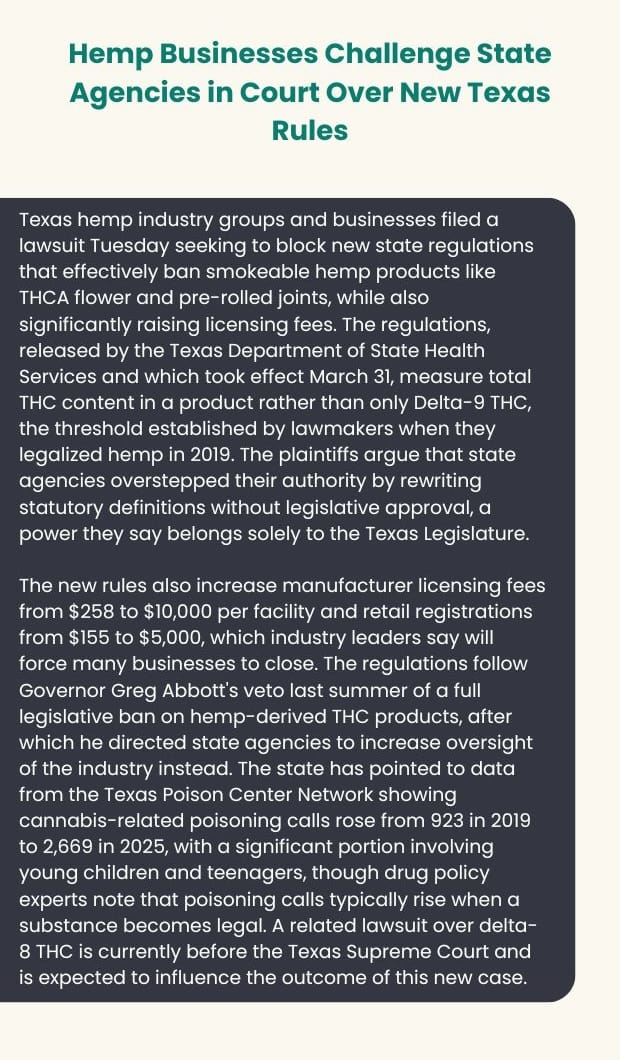
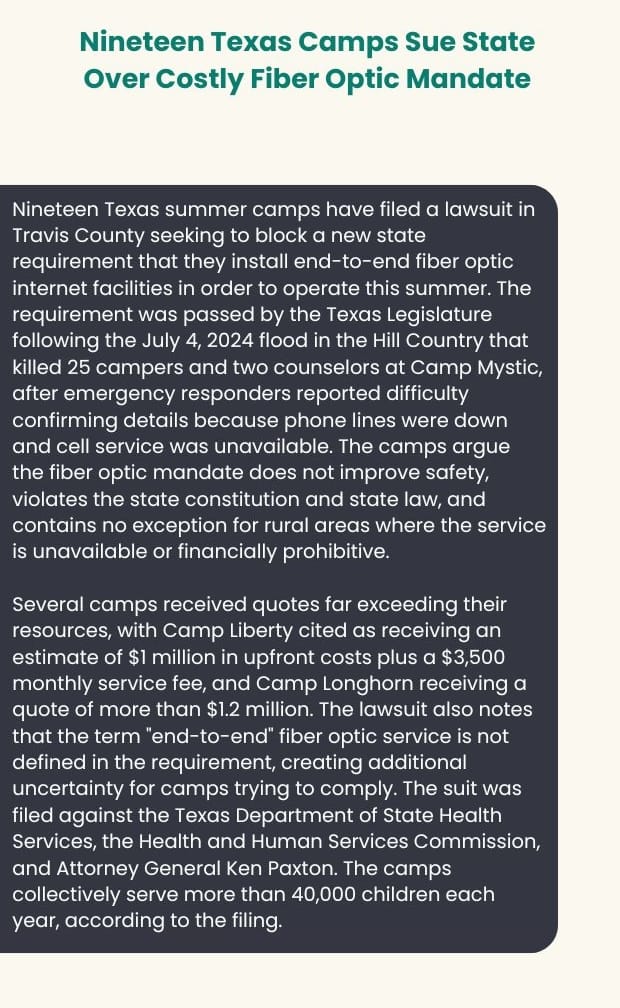
Texas hemp businesses have filed suit to block new state regulations they say effectively ban smokeable hemp products and impose licensing fee increases so steep they could force many businesses to close. Yesterday, the Texas House State Affairs Committee heard testimony on the explosive growth of data centers in the state, with interconnection requests on the power grid now exceeding 400,000 megawatts and raising questions about cost, reliability, and water usage. Lastly, nineteen Texas summer camps are challenging a new state mandate requiring them to install fiber optic internet infrastructure, citing costs as high as $1.2 million and arguing the requirement is unworkable for rural properties and does nothing to improve camper safety.

Before you dive in…

USLege will be hosting our first ever Best in Government Affairs Awards Ceremony on April 23rd at Speakeasy in Downtown Austin.

Winners and guests will be treated to evening of celebration for the accomplishments in the 89th Texas Legislative Session.

You can expect music, networking, food & drinks and formal award acceptance.  

This is going to be a fun party! We hope to see you there.

»» RSVP HERE: Best in Government Affairs Awards Ceremony hosted by USLege

»» Watch Representative Ken King’s Intro Here ««

We hope you enjoyed today’s read!

Stay connected with TXLege News on X and LinkedIn!

Texas Political Spotlight
This is some text inside of a div block.

Welcome back, friends

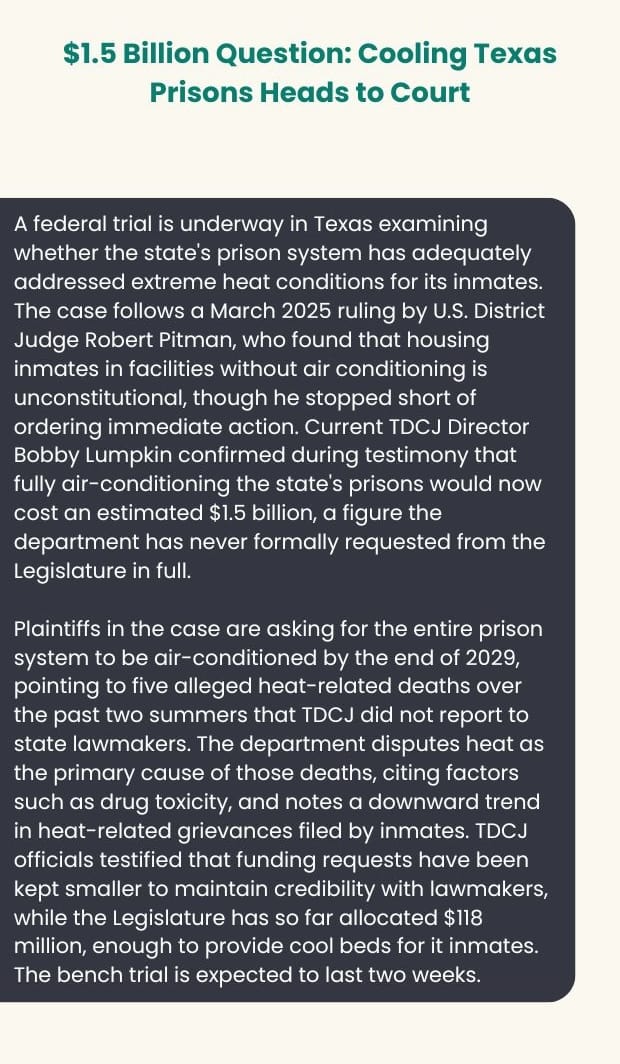
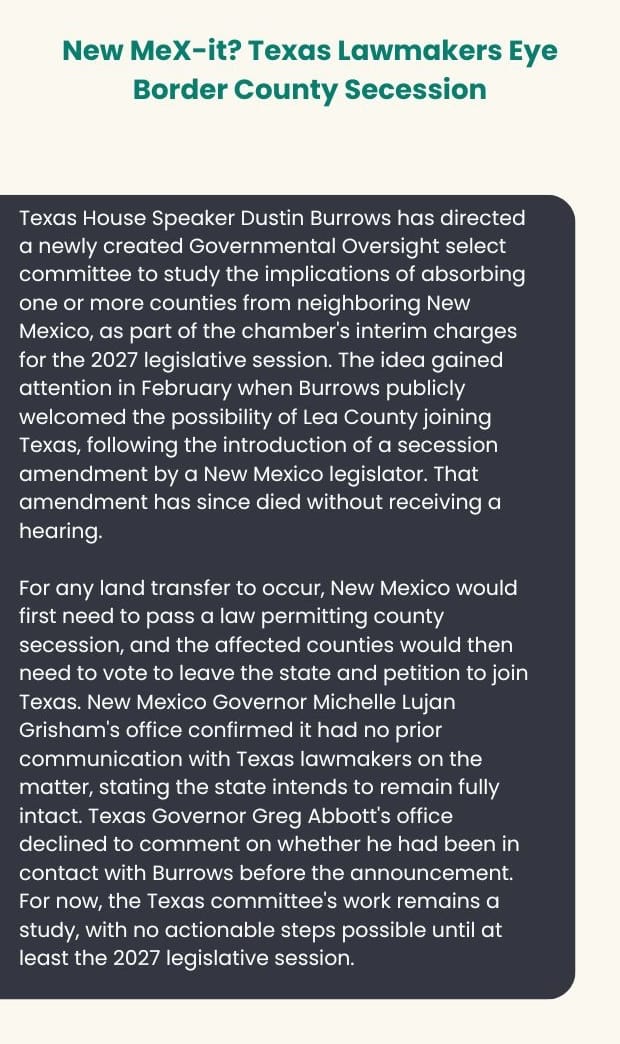
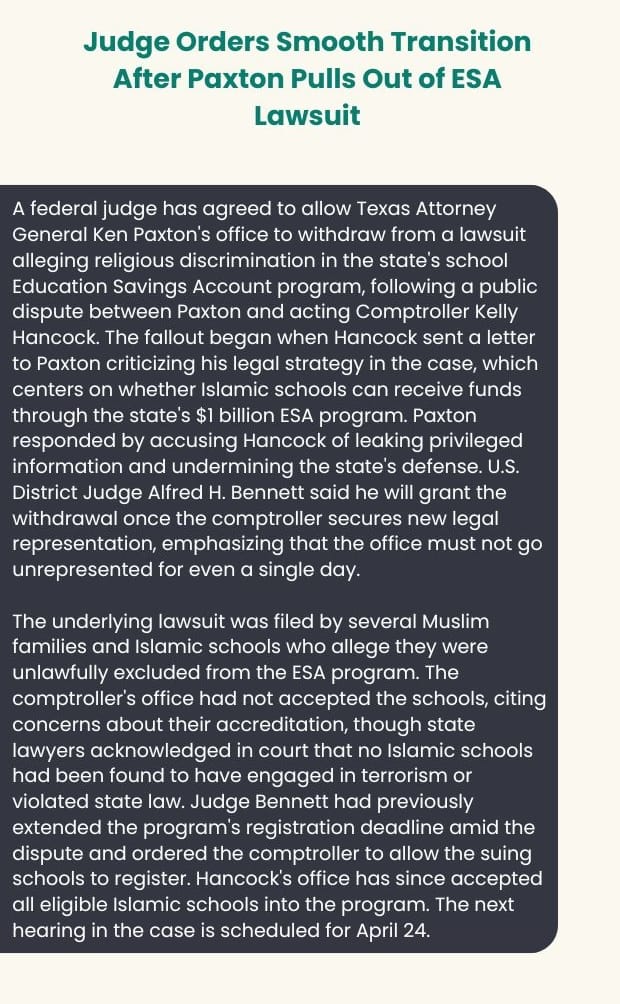
A federal trial is underway in Texas over whether the state's prison system has done enough to protect inmates from extreme heat, with a price tag of $1.5 billion standing at the center of the debate. Texas House Speaker Dustin Burrows has tasked a new legislative committee with studying whether Texas could absorb one or more counties from New Mexico, a long-shot proposal that has already drawn a sharp response from the neighboring state's governor. A public feud between Texas Attorney General Ken Paxton and acting Comptroller Kelly Hancock has spilled into federal court, where a judge is overseeing the fallout in a lawsuit alleging religious discrimination in the state's $1 billion ESA Program.

We hope you enjoyed today’s read!

Stay connected with TXLege News on X and LinkedIn!